
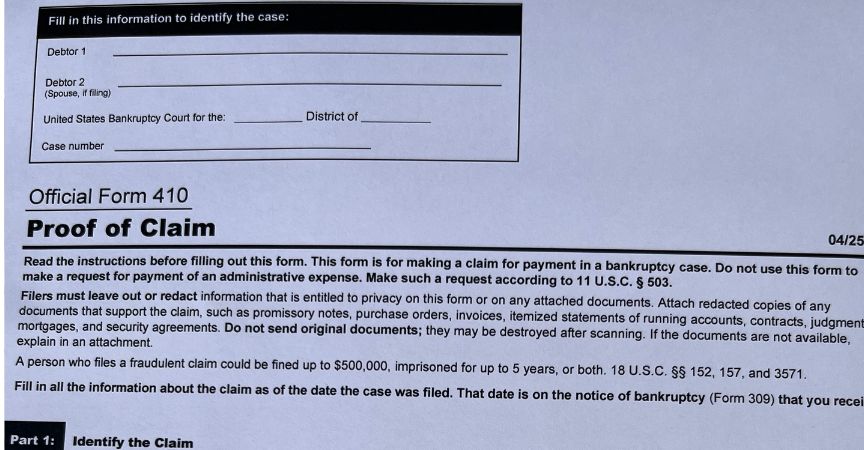
If you’ve received a U.S. Bankruptcy Court Form 10, or California Bankruptcy Court Form 410, Proof of Claim, in your bankruptcy, there is nothing for you to do. You are receiving a courtesy notification from the Bankruptcy Court because you are a party in your bankruptcy action. A Proof of Claim means one of your creditors applied for a share of any available funds in your bankruptcy estate.
What is a Proof of Claim?
When a creditor in a California bankruptcy files a Form 410 Proof of Claim, they are essentially raising their hand to join the “line” of creditors asking to be paid by the Bankruptcy Trustee administering the bankruptcy, in case there are any assets to be distributed. Determining whether there are assets that may be legally taken to repay creditors is one of the two main functions of the Bankruptcy Trustee, who functions like a judge in a bankruptcy case. The Trustee’s other, main job is to ensure the debtor filing bankruptcy meets the qualification criteria.
How does a creditor know about a bankruptcy?
Every creditor in a chapter 7 is automatically sent a Notice of a bankruptcy filing because they are listed in the bankruptcy petition filed by the debtor in Bankruptcy Court. The Notice of Bankruptcy the creditor receives also gives them the right to attend the 341 Hearing/Meeting of Creditors, in which a creditor may object to their debt being discharged. Making such an objection rarely results in the debt not being discharged and thus few creditors show up at the 341 Hearing. Instead the meeting consists mostly of the Bankruptcy Trustee asking the debtor about the truthfulness of the petition and about whether there are assets the Trustee may legally take to repay creditors.
Why Does the Debtor Receive a Proof of Claim?
Debtors are automatically copied on all Proof of Claim forms filed with the Bankruptcy Court because they are a party to this legal proceeding. By law, every party in a bankruptcy must be served all documents filed in the case. This means there are many documents debtors may receive that neither the debtor nor their attorney need to respond to. It’s the Bankruptcy Trustee’s job to verify the credibility of creditors’ claims, not the debtors’. Thus, a Proof of Claim functions more like an FYI, rather than an alert to action on your part.
Asset Bankruptcy Cases
If there is any money the Trustee may legally use to repay creditors, then the creditors who submitted Proofs of Claim will get a check, proportionate to the percentage of what they’re owed as a fraction of the total debt owed by all creditors filing proofs of claim. In other words, each creditor filing a Proof of Claim will be paid proportionate to their share of the debtor’s total debt. If a creditor fails to file a proof of claim, then they will not be paid by the Trustee; if they file the Form 410 late or incorrectly, then they will not be paid. Only creditors who have filed Proof of Claims timely and correctly are eligible for a payout.
The amount of money available in a bankruptcy estate for creditor payout varies widely and is a function of (1) what assets the Trustee was able to legally take from the debtor, and (2) how many other creditors file Proofs of Claim. If only one creditor files, then it gets all the money available. If several creditors file, they are paid proportionate to their share of the debtor’s total debt owed to those creditors filing 401s.
No Asset Bankruptcy Cases
In cases where there are no assets the Trustee may legally use to repay creditors, there is no money to pay out. Any creditor filing a proof of claim won’t be paid because there’s nothing to pay. A creditor can still file a proof of claim, but it’s essentially a waste of time if there’s no money in the bankruptcy estate. If a creditor doesn’t know whether there will be any money in the pot to repay creditors, then it’s worthwhile to file a Proof of Claim in case money is, or becomes, available. Usually the trustee will send an announcement that there are assets with instructions on how to file a claim.
Most chapter 7 bankruptcies are No Asset cases: there is no money the Trustee may legally take because any assets the debtor had were exempted either under the Homestead Exemption (which allows a debtor to take up to $750,000 in equity in a primary residence through BK) or the Wildcard Exemption (which allows a debtor to take approximately $40,000 in assets they choose — such as deposit or brokerage accounts or equity over $7,500 in a vehicle – through bankruptcy).
Questions? Call us at 818.889.8080
August 20, 2026